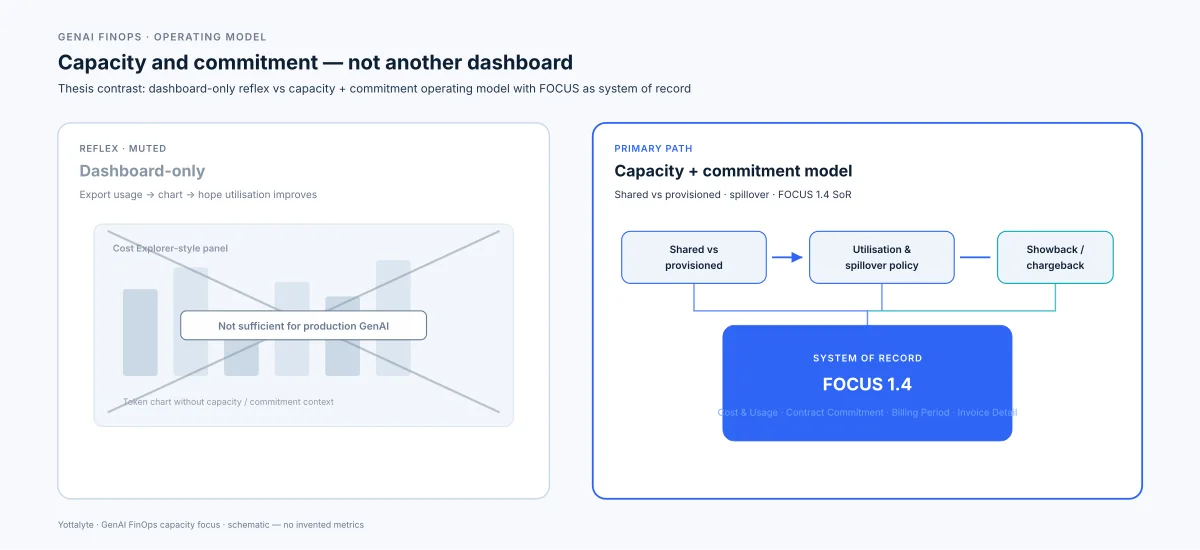
GenAI FinOps is a capacity-and-commitment operating model problem, not a dashboard problem. Shared versus provisioned decisioning, utilisation and spillover discipline, and normalisation into FOCUS 1.4 so allocation, commitment coverage, and invoice reconciliation share one cost system of record — that is the work. Dashboards are an output of that model, not a substitute for it.
What GenAI FinOps means in production
Why GenAI spend breaks “another cloud line item”
Classical FinOps still applies: price × quantity, tagging, showback, and commitment discounts remain the primitives. What changes is the meter mix and the ownership map.
Token-metered on-demand spend coexists with provisioned capacity billed whether traffic arrives or not. Bills diverge from simple usage exports because a large share of cost is allocated capacity, not consumed tokens. The FinOps Foundation’s FinOps for AI Overview (last updated 17 February 2026) notes the same FinOps approach with new meters, new stakeholders, and scarcity dynamics — including Crawl → Walk → Run maturity for AI cost management. Pilots tolerate pay-as-you-go. Production needs coverage targets, SLA owners, and a policy for what happens when reserved capacity is exhausted.
What still looks familiar
Tagging contracts, budget owners, anomaly detection, and commitment coverage ratios remain FinOps work. If your organisation already runs showback for compute and data platforms, you are not starting from zero — you are extending the operating model to a new cost shape.
What is structurally different
Model SKUs churn faster than most reserved-instance playbooks assume. Capacity can be scarce. Vendor TPM estimates often ignore the real input/output mix and cache behaviour. Reservation rigidities differ sharply by cloud: model-locked SKUs on one side, flexible capacity pools with different waste modes on the other. Cheaper per token is not always the goal — time-to-first-token (TTFT), output tokens per second (OTPS), privacy routing, and uptime can justify provisioned capacity even when unit token economics look worse.
Quality and evaluation of GenAI systems remain a separate production problem — covered in Moving Generative AI from Demonstration to Production. This article is the economic twin: capacity, commitments, and cost systems of record.
Shared vs provisioned: a traffic-shape and SLA decision
The FinOps Foundation working-group paper Navigating GenAI Capacity Options frames provisioned capacity as a strategic commitment, not merely a discount knob. That framing is the right starting point for implementation teams.
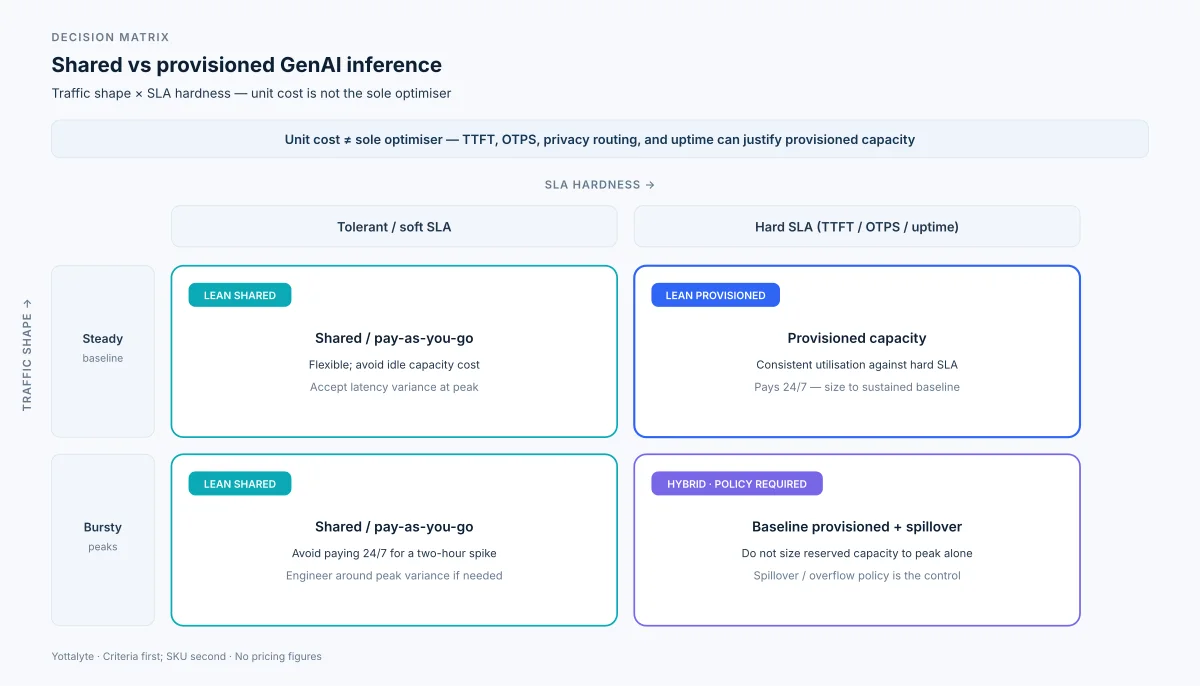
Shared / pay-as-you-go is flexible and avoids idle capacity cost. It does not dedicate performance. Latency variance at peak is an operating risk you either accept or engineer around.
Provisioned capacity pays for capacity around the clock. It wins on consistent, high utilisation against a hard SLA. It traps teams that size to peak for bursty, business-hours traffic — you pay 24/7 for a spike that lasts two hours.
Unit rates can make provisioned more expensive per token than standard even at high utilisation. That outcome is still correct when interactive copilots, PII-bound routing (“affinitisation”), or contractual uptime require dedicated capacity. Do not paste illustrative pricing tables from working-group papers as current market rates; re-check vendor pricing pages at purchase time.
Decision inputs implementation teams should force
Before anyone buys reserved throughput, force an explicit record of:
- Traffic shape — steady baseline versus bursty peaks.
- Latency / SLA tolerance — TTFT, OTPS, error budget.
- Data routing constraints — region, residency, and whether traffic must stay on provisioned paths.
- Model-switch likelihood over the commitment term.
- Multi-cloud model availability — whether the chosen foundation model forces a provider, not the reverse.
Not all reservations are equal: AWS rigidity vs Azure PTU pools
An AWS-first estate with Azure capability needs a common operating playbook, not dual marketing badges. The reservation semantics differ enough that a single “buy reserved, watch utilisation” checklist fails.
| Dimension | AWS Bedrock | Azure AI Foundry PTU |
|---|---|---|
| Capacity unit | Provisioned Throughput uses model-specific Model Units; the Reserved service tier reserves input and output TPM. | Provisioned Throughput Units provide processing capacity; effective tokens per minute vary by model. |
| Commitment / reservation | Provisioned Throughput includes no-commitment, one-month and six-month options; Reserved tier terms are commonly one or three months. | Deploy capacity first, then buy a reservation to discount the meter. A reservation does not guarantee deployable capacity. |
| Model-switch exposure | Longer commitments bind capacity more tightly to a model-specific shape, increasing model-switch risk. | Quota is model-independent, but quota is not the same as deployable model capacity. |
| Waste modes | Idle committed capacity is the central utilisation risk; overflow on Reserved paths can move to Standard. | Distinguish idle allocated PTUs from reserved-but-unallocated PTUs because the remediation differs. |
| Spillover / overflow | Reserved tier can auto-overflow to Standard; monitor the resolved service tier for attribution. | Supported models can spill selected failed provisioned requests to a matching Standard deployment; spilled tokens bill at Standard rates. |
| Billing evidence | CloudWatch dimensions such as ServiceTier and ResolvedServiceTier help separate reserved and overflow traffic. | Azure Monitor signals such as IsSpillover should be joined to billing and commitment records. |
AWS Bedrock: model-specific Provisioned Throughput and Reserved tier
Amazon Bedrock Provisioned Throughput purchases dedicated throughput billed hourly until deleted. Price depends on model, number of Model Units (MUs), and commitment duration. Commitment levels include no commitment, one month, and six months — longer terms buy a lower hourly rate and amplify model-lock risk when a better model ships mid-term. MUs define input and output tokens processable per minute; account teams often mediate precise MU meaning and limit increases.
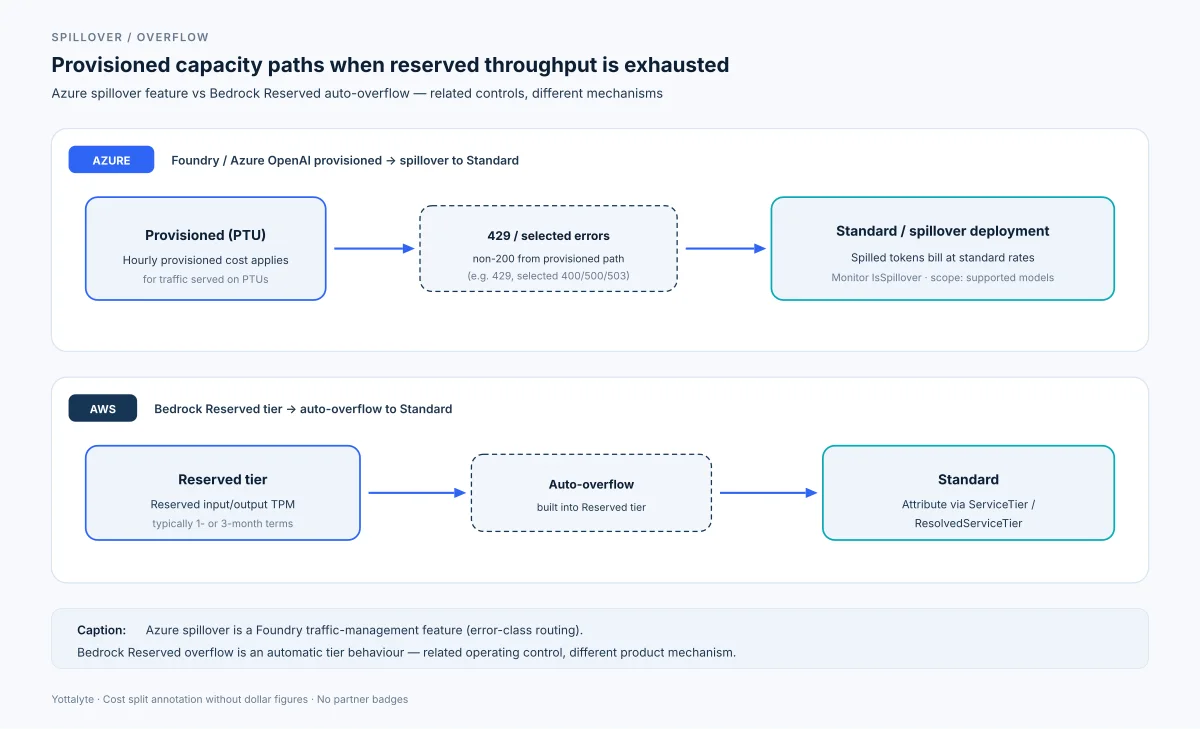
Separately, Bedrock service tiers include a Reserved tier: reserve input and output TPM separately, typically on one- or three-month terms, with auto-overflow to Standard, and a stated 99.5% uptime target. CloudWatch dimensions such as ServiceTier and ResolvedServiceTier matter for cost attribution when overflow fires. Public dollar figures on Bedrock pricing pages are incomplete for many SKUs (“contact account team”); cite mechanisms, not stale hourly rates.
Operating implication: longer AWS commitments bind you to a model-specific capacity shape. Treat model-switch risk as a first-class design input, not a procurement footnote.
Azure Foundry PTUs: flexible pool, two waste modes, reservation ≠ capacity
Azure AI Foundry provisioned throughput uses Provisioned Throughput Units (PTUs) as generic model-processing capacity. Quota is model-independent; tokens-per-minute per PTU vary by model. Microsoft’s guidance is consistent across billing docs: deploy first, then purchase a reservation. Reservations discount meters; they do not guarantee deployable capacity for the model you want. Quota is not capacity.
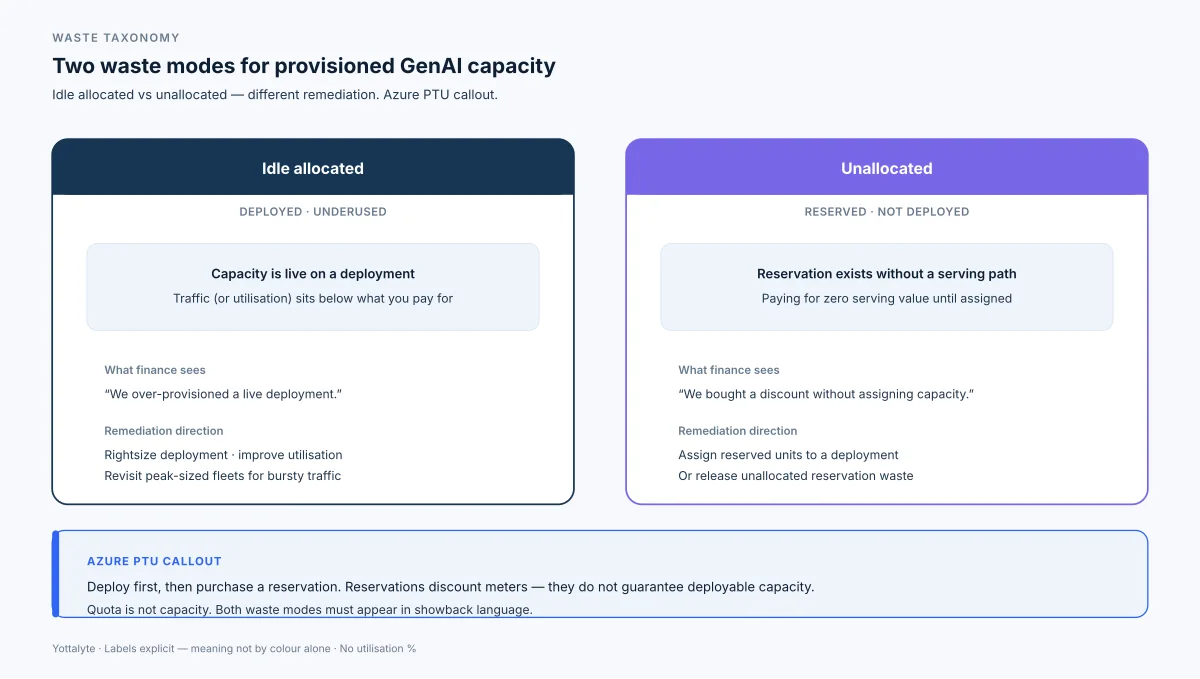
Two waste modes must appear in showback language:
- Idle allocated — deployed PTUs underutilised (paying for capacity that sits quiet).
- Unallocated — reserved PTUs not assigned to a deployment (paying for zero serving value).
Spillover is a first-class Azure control for supported Azure OpenAI Foundry models: on non-200 responses from provisioned paths (for example 429 when PTUs are exhausted, and selected 400/500/503 classes), traffic routes to a matching standard deployment. Spilled tokens bill at standard rates; provisioned hourly cost still applies for traffic served on PTUs. Monitor with Azure Monitor splits including IsSpillover. Scope matters: not every third-party Foundry model supports spillover.
Portfolio reality
No single hyperscaler hosts every foundation model an enterprise may adopt. Multi-vendor reservation portfolios are sometimes forced by model choice. Design one operating model — tagging, spillover policy, FOCUS joins, month-end sign-off — that works across AWS-first and Azure-capable estates. Do not confuse catalogue coverage with formal partner badges.
Waste, spillover, and the metrics that matter
Idle allocated vs unallocated
Finance needs to see why dollars are dark. Idle allocated capacity says “we over-provisioned a live deployment.” Unallocated reserved PTUs say “we bought a discount without assigning capacity to anything that serves traffic.” Conflating the two produces the wrong remediation: rightsizing a deployment will not fix unallocated reservation waste, and releasing unallocated reservations will not fix a chatty peak-sized deployment.
Spillover policy as an operating control
Spillover is not a bug — it is a control. Decide how much spillover is acceptable against the SLA. Attribute cost splits: provisioned hourly or reservation lines versus pay-as-you-go spillover lines must map to owners. On AWS Reserved paths, overflow to Standard is built in; on paths without native spillover, application-level failover must be engineered and tested, not assumed.
Load-test proof of TPM / UPM
Vendor TPM is a rough estimate. Output tokens cost more compute than input. Multimodal workloads need units-per-minute (UPM). A calculator screenshot is not handover evidence. Require load-test proof for the real prompt, response, and cache mix — peak and sustained — before locking commitment terms.
Wire telemetry and billing into FOCUS 1.4
Why 1.4 matters for GenAI commitments
The FOCUS Steering Committee ratified FOCUS 1.4 on 4 June 2026 (FinOps Foundation introduction, published 10 June 2026). The release adds Invoice Detail and Billing Period datasets, expands Contract Commitment from 13 to 30 columns, adds commitment-program eligibility tracking (what was coverable, not only what was covered), and introduces integrity attributes for corrections, delivery, completeness, and configuration.
For GenAI estates, the practical use cases are durable:
- Reconcile usage to invoices (Invoice Detail + Billing Period).
- Compare commitments across providers from one Contract Commitment dataset.
- Measure coverable versus covered spend.
- Treat FOCUS as the cost system of record rather than a parallel export.
Join Cost and Usage to Contract Commitment via Contract Commitment ID, carried as a property inside the Cost and Usage Contract Applied (ContractApplied) JSON column (Contract Commitment dataset). Respect Billing Period Status: Open periods are preliminary; Closed periods are what formal showback and chargeback should sign off against.
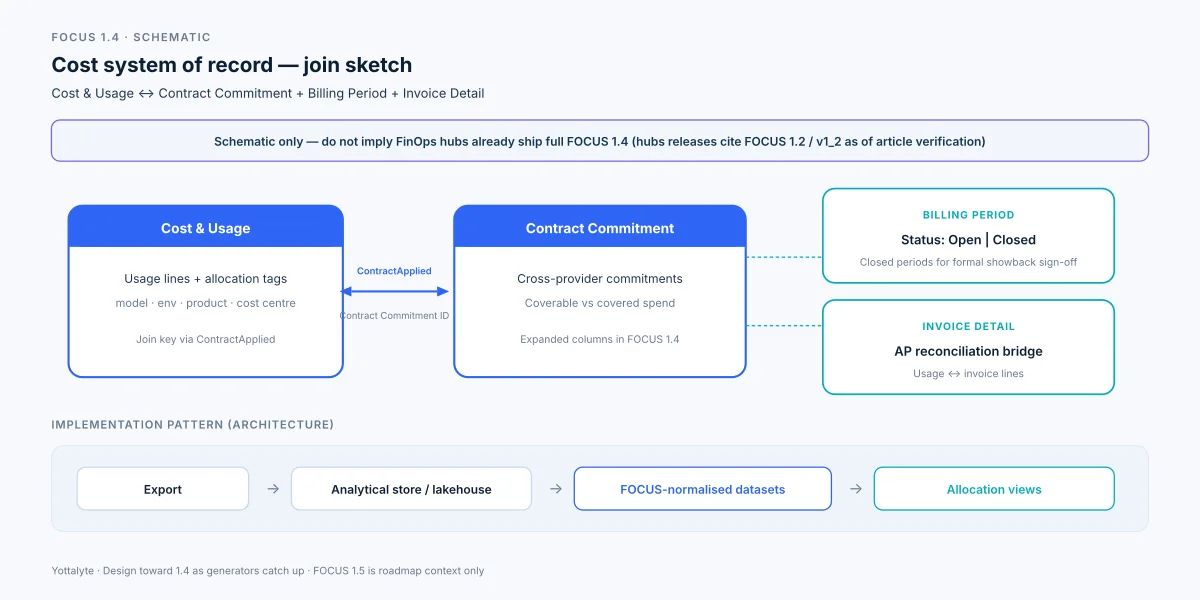
The FinOps Foundation announced FOCUS Validator support for 1.4 for later in Q3 2026. That window has closed; the hosted Validator still only offers specification versions 1.2 and 1.3. Treat Validator 1.4 conformance tooling as unavailable until the official Validator (or Conformance Program) lists 1.4. FOCUS 1.5 remains roadmap context — native AI model identity, token consumption, and a Price Sheet — not columns to design against as if they already ship.
Allocation and showback contract
Start from FinOps-for-AI tagging patterns — model, environment, product, cost centre, criticality — and adapt them to your tenancy model. Join application telemetry (tokens, service tier / ResolvedServiceTier, spillover flags) to FOCUS Cost and Usage and Contract Commitment. Without that join, utilisation dashboards and invoices remain two disconnected truths.
Implementation pattern (architecture, not product pitch)
Export → analytical store / lakehouse → FOCUS-normalised datasets → allocation views. On Azure-capable estates, Microsoft FinOps hubs illustrate an open, FOCUS-aligned hub pattern. Microsoft Learn documents FinOps hubs releases 12+ as using schema v1_2 aligned to FOCUS 1.2 — design toward 1.4 columns and datasets as generators and toolkits catch up. As documented today, hubs do not yet implement full 1.4 Invoice Detail or the expanded Contract Commitment shape. AWS-first estates use the same logical model even when the store is object storage plus a warehouse or lakehouse rather than Azure Data Explorer.
This is supporting cost-pipeline architecture only — not a restatement of What a Production-Grade Modern Data Platform Actually Needs.
What implementation teams must hand over
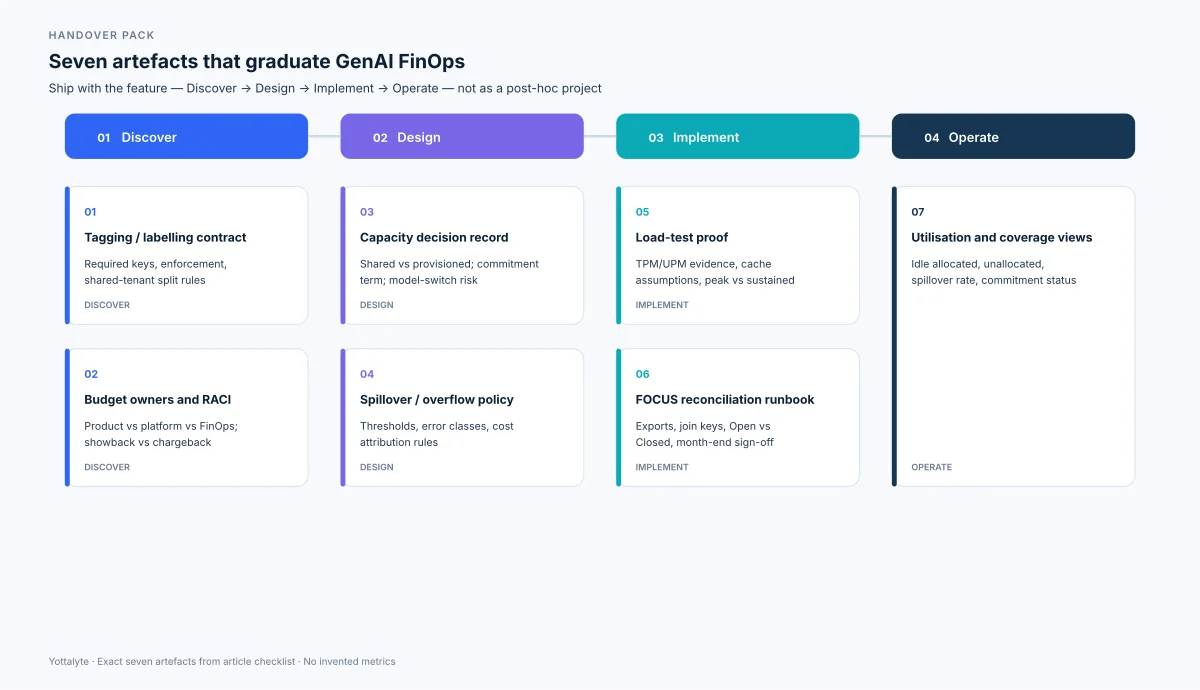
Dashboards without artefacts do not graduate GenAI FinOps. Ship this operating pack with the feature — aligned to Discover → Design → Implement → Operate — not as a post-hoc FinOps project:
- Tagging / labelling contract — required keys, enforcement point, shared-tenant split rules.
- Budget owners and RACI — product versus platform versus FinOps; showback versus chargeback stage.
- Capacity decision record — shared versus provisioned rationale; commitment term; model-switch risk.
- Spillover / overflow policy — thresholds, allowed error classes, cost attribution rules.
- Load-test proof — TPM/UPM evidence, cache assumptions, peak versus sustained.
- FOCUS reconciliation runbook — which exports, join keys, Open versus Closed billing-period handling, who signs off month-end.
- Utilisation and coverage views — idle allocated, unallocated, spillover rate, commitment lifecycle status — owned in the operate phase.
For consulting and SI partners, white-label and co-delivery succeed when these artefacts travel with the feature. The partner retains client and commercial ownership; implementation capacity is accountable for the handover, not for inventing a parallel FinOps product narrative.
Trade-offs worth arguing explicitly
| Trade-off | Lean when… |
|---|---|
| Unit-cost savings vs SLA / latency | Interactive copilots, PII-bound traffic, hard TTFT/OTPS targets |
| AWS model predictability vs Azure PTU pool flexibility | Stable model choice for the term vs frequent model upgrades inside a flexible pool |
| High provisioned coverage vs spillover savings | Hard SLOs vs cost-optimised batch or async workloads |
| Early FOCUS 1.4 adoption vs waiting for generator / Validator conformance | Need AP reconciliation and cross-provider commitment comparability now vs tooling lag |
There is no universal winner. Criteria first; SKU second.
What this is not
- Not a FinOps tool listicle or “top ten” vendor roundup.
- Not a console tutorial for Bedrock purchase wizards or Azure reservation click-paths.
- Not a rewrite of GenAI evaluation, RAG provenance, or agent tool constraints — see production GenAI.
- Not a claim of FinOps Foundation membership, FOCUS contribution, or formal cloud partner tiers — technology names here are capability and coverage language.
- Not training-cluster FinOps; scope is managed inference capacity (Bedrock, Foundry, and comparable managed inference).
Operational implications
If GenAI FinOps is only a dashboard, it will stall the moment commitment terms, spillover lines, and AP invoices disagree. The durable deliverable is an operating model: capacity decision records, spillover policy, load-test proof, and FOCUS 1.4 joins that make showback and invoice reconciliation one system of record.
That work sits at the intersection of AI & Intelligent Systems, Cloud, Platform & DevSecOps, and Managed Data, AI & Cloud Operations — including FinOps named under managed operations — and it extends naturally into Production AI & Agentic Systems when the economic controls must ship with the product path. Prefer durable cost governance over impressive token charts.
FAQ
When is provisioned capacity still correct if it is more expensive per token?
When SLA, TTFT/OTPS, privacy routing, or contractual uptime require dedicated capacity. Unit-token cost is one criterion among traffic shape and risk — not the sole optimiser.
Does an Azure PTU reservation guarantee you can deploy a new model?
No. Microsoft documents that reservations discount meters and do not guarantee capacity; deploy first, then reserve. Quota is not capacity.
What does FOCUS 1.4 add that Cost and Usage alone cannot answer?
Invoice Detail and Billing Period bridge FinOps to accounts payable; expanded Contract Commitment and eligibility tracking answer coverable versus covered and cross-provider commitment structure — not only “what did we use?”
References
Primary sources used for technical claims in this article. Inline citations in the body remain authoritative for locus of each claim.
Verification date: 1 October 2026.
- Introducing FOCUS 1.4 — FinOps Foundation
- FOCUS specification
- Contract Commitment dataset (FOCUS 1.4)
- GenAI Capacity Options — FinOps Foundation Working Group
- FinOps for AI Overview — last updated 17 February 2026
- Amazon Bedrock Provisioned Throughput
- Amazon Bedrock service tiers (inference)
- Azure AI Foundry provisioned throughput
- Azure provisioned throughput billing
- Azure spillover traffic management
- Microsoft FinOps hubs overview
- Microsoft FinOps hubs data model
Planning GenAI capacity and FinOps for production?
YottaLyte works with consulting partners, technology vendors and enterprises across Data, AI, Cloud and Platform Engineering.
Discuss a project →