A production GenAI system is an application in which model behaviour is constrained by governed context, explicit permissions, evaluated workflows, observable runtime controls and safe failure paths rather than relying on a prompt alone.
The gap between a demo and a system
Demos optimise for visible capability: an answer appears quickly and looks plausible. Production environments introduce a different set of concerns. The user may not be authorised to see every source. Retrieved documents may be stale or contradictory. Tools may change external systems. The model may produce an answer that is fluent but unsupported. A vendor model may become unavailable or materially change behaviour.
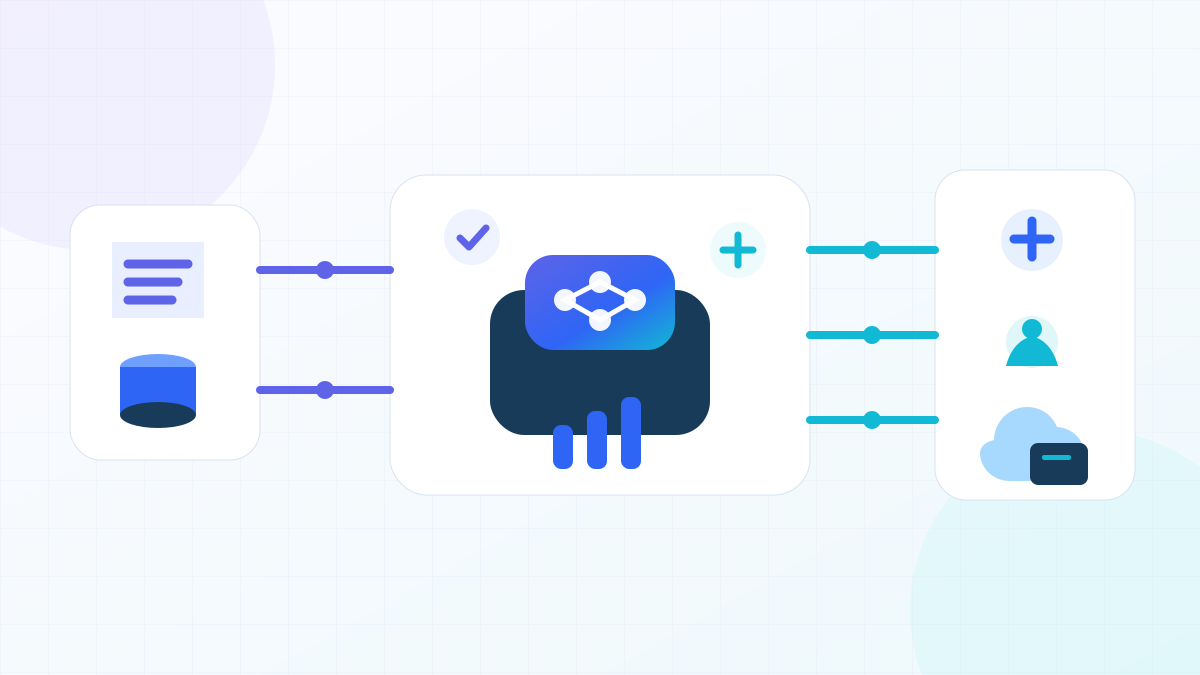
Engineering for production therefore means designing the entire request path: identity, context assembly, retrieval, model invocation, tool access, validation, logging, escalation and recovery. The model is one component inside that path.
Start with the decision or workflow being automated
The strongest GenAI implementations begin with a bounded business task rather than “add AI”. Define what the user is trying to achieve, which information sources are authoritative, what actions are allowed, what must remain human-controlled and what an acceptable failure looks like.
This creates the basis for evaluation. If success cannot be described independently of the model, teams often end up measuring latency and token consumption while missing whether the application is actually useful, safe or correct enough for its purpose.
Retrieval needs governance, not only embeddings
RAG can improve grounding, but it does not automatically make responses trustworthy. The system still needs to know which sources are allowed for the current user, which documents are authoritative, how freshness is handled and how citations map back to the material used in generation.
Retrieval design should therefore include metadata, tenancy, document ownership, source ranking and permission filtering before context reaches the model. Chunking and vector search are implementation details inside a broader information-governance problem.
- Apply access controls before retrieval results are added to the prompt.
- Record source identifiers and versions for traceability.
- Prefer authoritative sources when multiple documents disagree.
- Define freshness expectations for operational knowledge.
- Keep sensitive context out of prompts when it is not required for the task.
Evaluation should run before and after release
Production evaluation needs a representative test set tied to real workflow risks. Useful measures may include groundedness, task completion, citation correctness, tool-selection accuracy, refusal behaviour and human preference. The exact metrics depend on the application; there is no universal score that proves a system is safe or useful.
Evaluation should also continue after deployment. Prompts, retrieval data, tool schemas and model versions change. A system can regress even when the application code is untouched. Release gates and periodic re-evaluation make that drift visible.
Tool use raises the engineering stakes
An assistant that only drafts text has a different risk profile from an agent that can create tickets, update customer records, query privileged systems or trigger workflows. Tool execution should be treated like API access: validate arguments, restrict available actions, enforce identity and authorisation, log execution and design compensating or rollback paths where actions are reversible.
High-impact actions may require human approval. The objective is not to remove autonomy; it is to align autonomy with business risk. A read-only knowledge query can often operate with less friction than an irreversible financial or operational action.
Observability should reconstruct the reasoning path
Teams need enough telemetry to understand what happened without logging sensitive content indiscriminately. A useful trace can include request identity, retrieved source references, prompt or template version, model and parameters, tool calls, latency, token or cost data, validation results and final outcome. Sensitive payloads should be handled according to the application's data policy.
Operational dashboards should separate application failures from model behaviour. A retrieval timeout, malformed tool response and low-confidence answer require different owners and different remediation paths.
Design failure and escalation deliberately
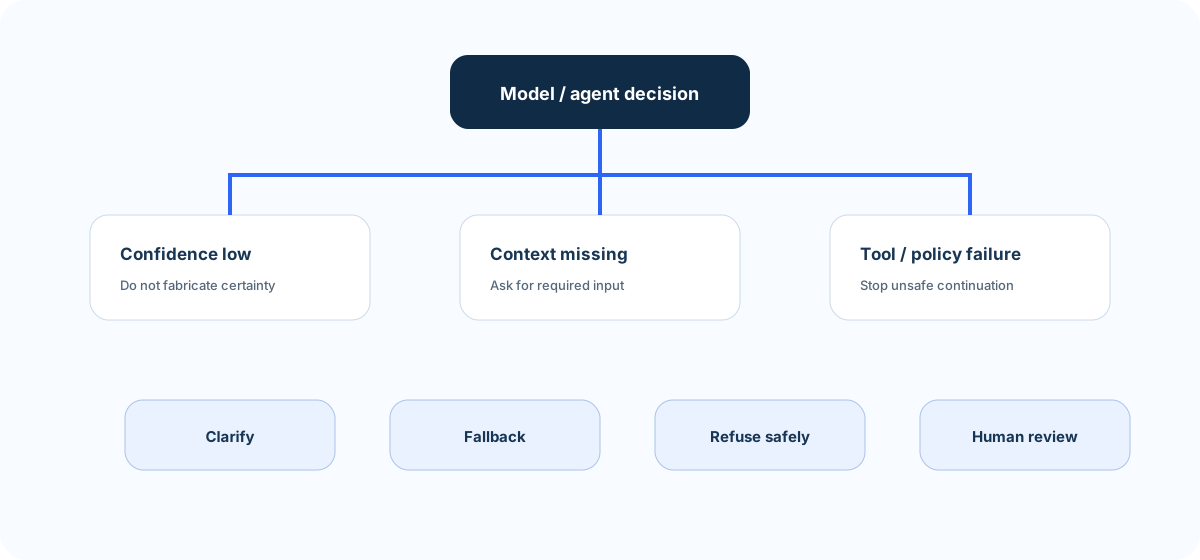
Every GenAI workflow should define what happens when confidence is low, required context is unavailable, a tool fails or the task is outside policy. Safe refusal, deterministic fallback, retry and human escalation are architectural choices. They should be tested before users discover them in production.
For high-value workflows, the handover to a person should preserve context: the user request, sources consulted, actions attempted and reason for escalation. That prevents “human in the loop” from becoming “human starts again from zero”.
Production GenAI readiness checklist
- The use case has a bounded task, owner and measurable success criteria.
- Retrieval honours identity, tenancy and source authority.
- Representative evaluations exist and run during change or release.
- Tool access is explicitly authorised and validated.
- Prompt, model, retrieval and tool versions are traceable.
- Observability covers quality, latency, errors and cost without unnecessary sensitive logging.
- Fallback, refusal and human-escalation paths are tested.
- Operational ownership is clear after go-live.
Frequently asked questions
Is RAG enough to make a GenAI application production-ready?
No. RAG can improve grounding, but production readiness also requires permissions, evaluation, tool controls, observability, failure handling and an operating model.
When should an AI agent require human approval?
Approval is most useful for high-impact, irreversible or policy-sensitive actions. Lower-risk read or draft workflows can usually operate with less intervention when identity and permissions are already controlled.
What should teams monitor after launch?
Monitor quality signals, retrieval failures, tool errors, latency, cost, model or prompt changes, escalation rates and user outcomes. The exact set should reflect the business workflow and its failure modes.
Taking an AI workflow from prototype to production?
YottaLyte supports RAG, agentic systems, integration, evaluation and production engineering across Data, AI, Cloud and Software.
Discuss a project →