Platform engineering is the design and operation of reusable internal capabilities that give delivery teams a safe, observable and repeatable path from code to production while preserving necessary security and governance controls.
Infrastructure automation is not automatically a platform
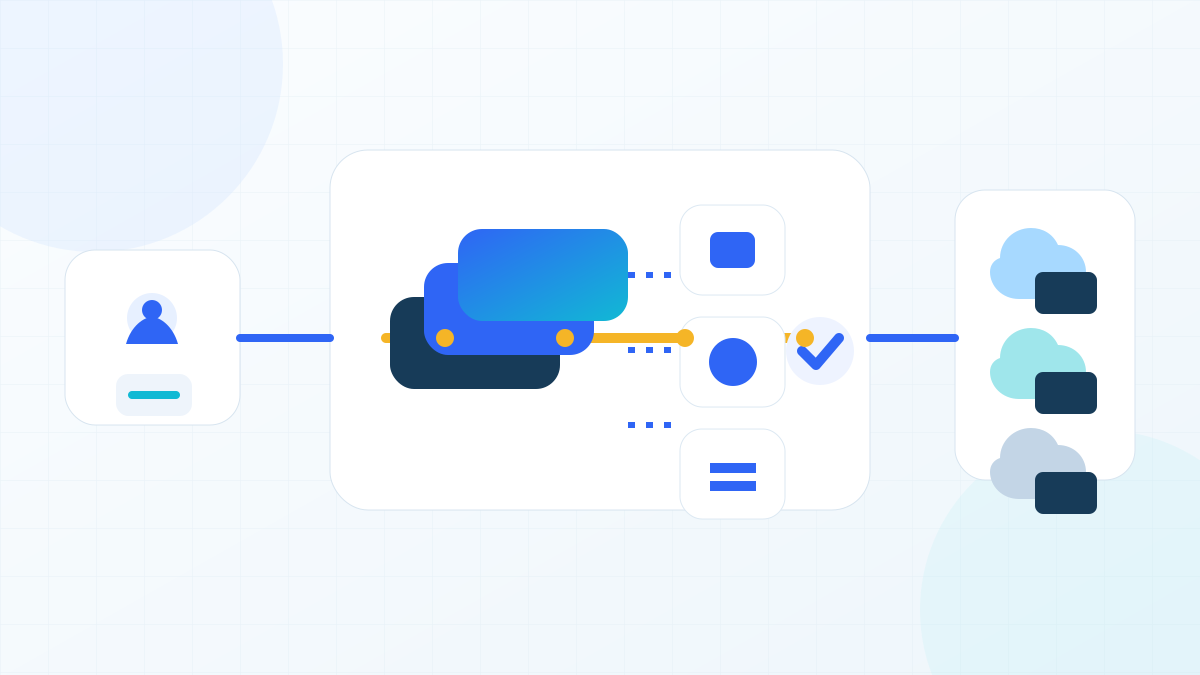
Many organisations accumulate Terraform modules, Kubernetes clusters, pipeline templates and cloud accounts, then call the collection a platform. Those assets can be useful, but they do not by themselves create a coherent developer experience. If every team must understand the full infrastructure stack, negotiate access manually and rebuild the same deployment decisions, cognitive load has simply moved into another repository.
A platform becomes valuable when it turns repeated engineering decisions into supported capabilities. Teams should know the recommended path for creating a service, storing secrets, deploying safely, exposing telemetry, requesting data access and recovering from failure. Exceptions remain possible, but the common path should be easier than creating a bespoke solution.
Treat the platform as an internal product
The users of a platform are engineering teams, data teams and service owners. Their needs should shape the roadmap. That means understanding where delivery slows down, which controls create repeated friction, where incidents originate and which responsibilities are unclear.
Product thinking also changes how success is measured. A platform should not be judged primarily by how many tools it contains. Better measures include adoption of supported paths, lead time to production, deployment failure rate, time to recover, policy compliance, self-service completion and the volume of bespoke support requests that remain.
Paved roads need escape hatches
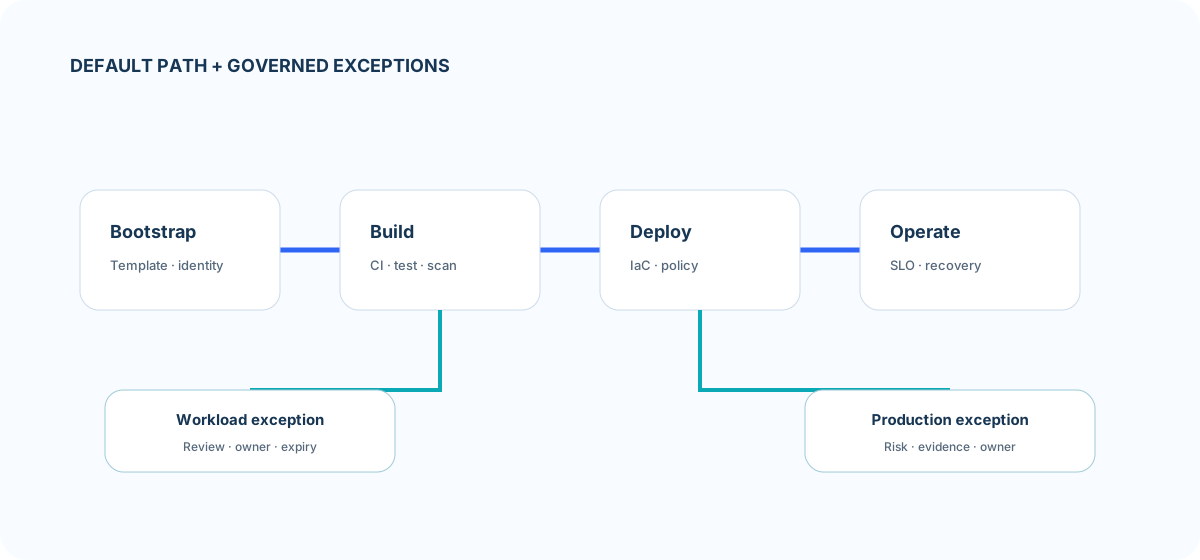
A golden path should encode the organisation's default architecture, not become a rigid abstraction that blocks legitimate workloads. The platform team should make supported patterns obvious while defining how exceptions are reviewed and owned.
This is especially important in mixed environments. Data pipelines, APIs, event-driven services and GPU workloads do not have identical runtime needs. A strong platform provides shared identity, networking, delivery controls and observability while allowing workload-specific components where the business case is clear.
Build the control plane around ownership
Self-service does not mean “anything goes”. The platform should make ownership more explicit. A service should have a responsible team, environment, repository, deployment path, observability configuration and operational expectations that can be traced without relying on institutional memory.
Identity and access are central. Prefer short-lived credentials and managed identities over shared secrets. Keep environment and customer boundaries explicit. Make privileged actions auditable. The platform should reduce the effort required to comply with these controls instead of forcing every team to reimplement them.
Observability must be part of the paved road
Teams should not discover after launch that dashboards, alerts or traces were optional extras. Standard service templates can include baseline telemetry, health checks, release metadata and ownership tags. That creates a consistent operational view and makes incident response less dependent on which team built the workload.
The platform team should avoid creating alert noise. Defaults need to be useful, with clear routes for service-specific indicators and objectives. The goal is to establish a common operational foundation while leaving domain teams responsible for what “healthy” means for their service.
Deployment safety is more than CI/CD
A pipeline that can deploy quickly is not necessarily safe. Production delivery should include appropriate review, testing, policy checks, environment promotion and rollback or recovery options. The exact controls depend on risk, but they should be encoded consistently rather than rediscovered during each release.
Reusable infrastructure also needs versioning and change discipline. Platform components are dependencies for many teams. Breaking a module interface or policy can create organisation-wide delivery risk, so compatibility, migration guidance and deprecation windows matter.
Cost and capacity belong in platform design
Cloud platforms make it easy to create resources, which means self-service can amplify waste if cost visibility is absent. Platform capabilities should expose ownership, environment and workload metadata needed for allocation, and sensible defaults should discourage unnecessary capacity. FinOps is easier when tagging, account structure and resource lifecycle are part of the platform rather than retrospective reporting.
Measure whether the platform is actually reducing friction
Adoption is the strongest signal. If teams repeatedly bypass the platform, the platform team should investigate whether the supported path is too slow, too restrictive or poorly documented. Internal platforms should earn usage by solving delivery problems.
- Time from repository creation to first controlled deployment.
- Percentage of services using supported templates and delivery paths.
- Deployment success and recovery performance.
- Self-service completion rate for common environment and access tasks.
- Number of repeated manual support requests.
- Coverage of ownership, observability and cost metadata.
| Metric | What it measures | Why it matters |
|---|---|---|
| Time to first controlled deployment | Elapsed time from repository/bootstrap to a governed deployment. | Shows onboarding and platform-path friction. |
| Change-failure / recovery performance | How often releases fail and how quickly safe service is restored. | Balances delivery speed with operational safety. |
| Supported-path adoption | Share of services using standard templates and delivery paths. | Shows whether teams choose the paved road voluntarily. |
| Self-service completion | Common environment or access tasks completed without manual platform-team intervention. | Measures whether the platform actually removes queues. |
| Repeated support requests | Volume of recurring manual tickets for known platform tasks. | Highlights missing or poorly designed platform capabilities. |
Platform engineering readiness checklist
- Supported golden paths exist for the most common workload types.
- Identity, secrets, network and environment boundaries are built into the path.
- Templates include baseline testing, scanning and observability.
- Exception processes are explicit rather than informal.
- Platform components are versioned and have upgrade guidance.
- Ownership and operational expectations are discoverable.
- Cost allocation metadata and lifecycle controls exist by default.
- Platform adoption and delivery outcomes are measured.
Frequently asked questions
Is Kubernetes required for platform engineering?
No. Platform engineering is about reusable delivery capabilities and operating controls. Kubernetes can be part of the runtime, but the platform may also support serverless, managed services, data workloads or other execution models.
What is the difference between DevOps and platform engineering?
DevOps describes cultural and operational practices that reduce the boundary between delivery and operations. Platform engineering applies product thinking to reusable internal capabilities that make those practices easier to adopt consistently.
How do we know whether an internal platform is working?
Look for adoption and delivery outcomes: faster safe deployment, fewer repeated manual tasks, clearer ownership, lower recovery time and less need for bespoke infrastructure support.
Building or rationalising an internal platform?
YottaLyte supports cloud foundations, IaC, Kubernetes, CI/CD, observability and production operating models across partner and enterprise programmes.
Discuss a project →