Modern data, cloud & AI ecosystem

Technology capability for modern Data, AI & Cloud systems.

Engineering coverage spans cloud platforms, distributed compute, lakehouse and warehouse systems, orchestration, streaming, BI, governance, DevOps and AI/ML tooling.
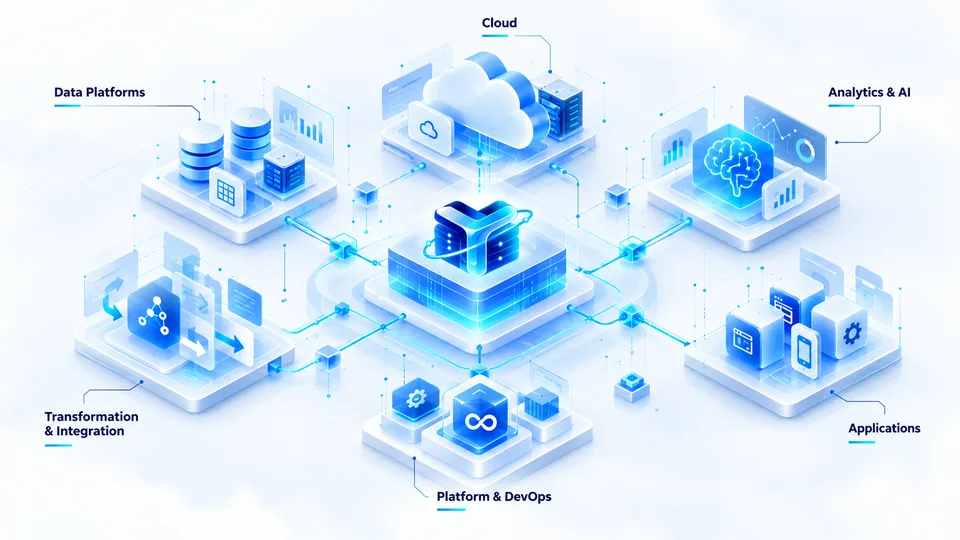
Technology ecosystem connecting cloud, data platforms, integration, DevOps, analytics, AI and applications.
Technology ecosystem

Platforms selected for workload and operating fit.

Tool selection follows architecture requirements, data volume and velocity, security, integration constraints, operating model, team ownership and total lifecycle cost.

Cloud Platforms3 capabilities
AWS
Microsoft Azure
Google Cloud Platform
Data Processing & Lakehouse6 capabilities
PySpark
Apache Spark
Databricks
Delta Lake
Apache Iceberg
Hadoop
Warehouses & Query Engines7 capabilities
Snowflake
BigQuery
Amazon Redshift
Azure Synapse
Microsoft Fabric
ClickHouse
Trino / Starburst
Transformation & Orchestration7 capabilities
dbt
Apache Airflow
Astronomer
Dagster
Prefect
AWS Glue
Azure Data Factory
Streaming & Data Movement6 capabilities
Apache Kafka
Debezium / CDC
Airbyte
Fivetran
Amazon Kinesis
Google Pub/Sub
Databases & Storage10 capabilities
PostgreSQL
MySQL
SQL Server
Oracle
MongoDB
Redis
Cassandra
Amazon S3
ADLS
GCS
Analytics & BI6 capabilities
Power BI
Tableau
Looker
Sigma Computing
Apache Superset
Semantic / Metric Layers
Governance, Quality & Observability9 capabilities
Unity Catalog
Microsoft Purview
Collibra
Alation
DataHub
Great Expectations
Soda
Monte Carlo
OpenLineage
Platform & DevOps9 capabilities
Terraform
Docker
Kubernetes
GitHub Actions
GitLab CI/CD
Jenkins
Azure DevOps
Datadog
Grafana
Languages & Engineering8 capabilities
Python
PySpark
SQL
Scala
Java
Bash
REST APIs
GraphQL
Enterprise Applications & Sources8 capabilities
Salesforce
SAP
Odoo
SFTP
JSON
CSV
Parquet
Avro
AI / ML Engineering8 capabilities
MLflow
scikit-learn
PyTorch
TensorFlow
Vector Databases
LLM APIs
RAG
Agentic Workflows
How to read the gridPlatform fluency does not imply equal depth in every tool; architecture, workload, security and ownership determine the final stack.
Engineering methods

Architecture at a glance.

A clean operating model connects cloud foundations, data platforms, analytics and AI, applications and production operations without turning the stack into a catalogue.

FoundationCloud & PlatformIdentity · network · IaC · runtime
MovementIngest & IntegrateBatch · streaming · APIs · orchestration
DataStore & ModelLakehouse · warehouse · semantic layers
IntelligenceAnalytics & AIBI · ML · RAG · agents
OperateGovern & RunQuality · security · observability · FinOps
Platform alignment

Match the technology ecosystem to the implementation requirement.

YottaLyte can align architecture, data engineering, cloud platform and AI capability to your current stack or target platform.

Technology questions

Choose platforms by operating requirements.

No. Platform selection follows architecture, workload, security, integration and operating constraints. YottaLyte can work across AWS, Azure and Google Cloud and with modern lakehouse, warehouse, orchestration and streaming technologies.

Yes. Implementation can be scoped around an existing platform, identity model, network boundary and governance standard. The work may include ingestion, transformation, quality, orchestration, observability, security integration and operational handover.

Selection should be tied to workload characteristics, team ownership, data volume and velocity, security, integration constraints, lifecycle cost and existing standards. A tool is not recommended simply because it appears in the technology ecosystem.

Yes. Testing, observability, access, recovery, documentation, cost visibility and handover are treated as cross-cutting controls rather than optional additions after the platform is built.