Efficiency in ETL versus ELT is not which letters you brand the pipeline with. It is a placement problem, a recompute policy problem, and a coupling problem. Cloud platforms document both patterns as valid; hybrid across sources is normal. The useful question for architecture and delivery teams is which transform plane fits the workload — and which waste modes you are willing to own after handover.
ETL and ELT in an efficiency sense
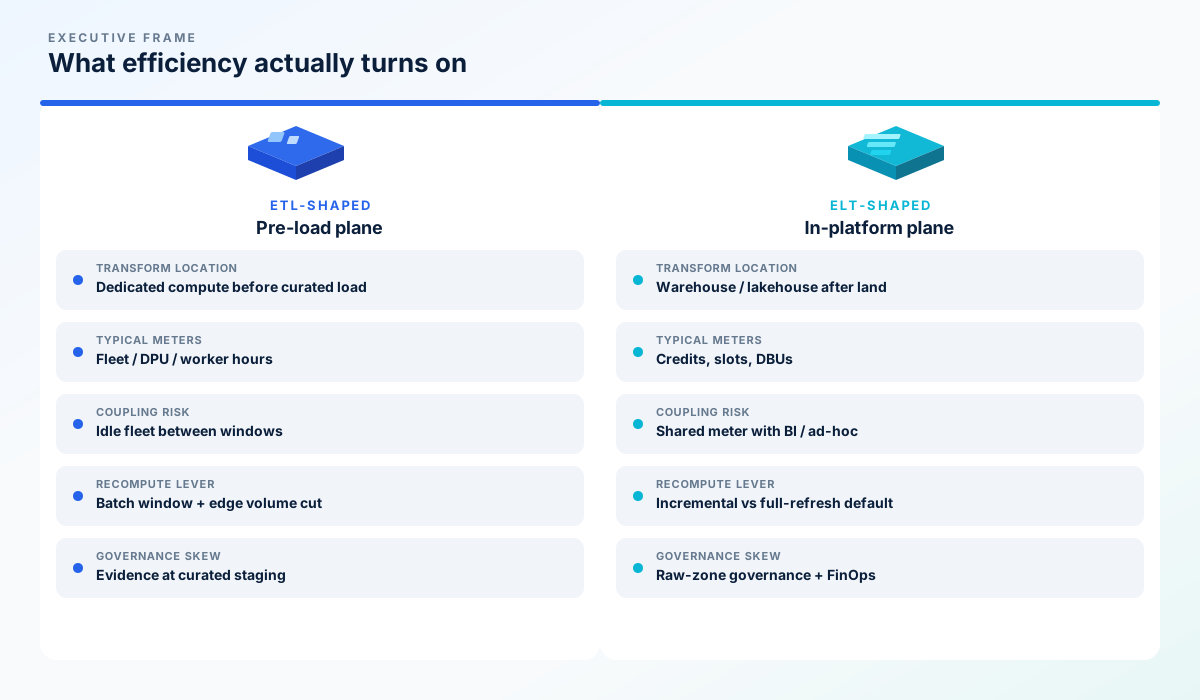
ETL / ELT (efficiency sense): Two sequencing patterns for getting analytics-ready data into a consumer store. ETL transforms on dedicated pre-load compute, then loads curated results. ELT loads raw or lightly prepared data into a warehouse or lakehouse first, then transforms with that platform’s compute. Efficiency follows transform location, recompute policy, and coupling to credits, slots, or DBUs — not the letters on the architecture slide.
The acronym is not the cost model
AWS and Microsoft both frame the primary difference as where transformation happens: on a secondary processing engine before load, or inside the target store after load (AWS compare; Azure Architecture Center). Removing a separate transform engine can simplify the architecture — but only when the target is powerful enough to transform efficiently. That caveat is the efficiency argument in one sentence.
Cloud documentation endorses both patterns and contemplates hybrid use across sources. “ELT replaced ETL” is a marketing view, not vendor-doc consensus. Efficiency, for operators, is a triad you can manage:
- Location — dedicated fleet versus warehouse or lakehouse compute.
- Recompute — incremental materialisation versus full rebuild as the quiet default.
- Coupling — whether transforms share the same credits, slots, or DBU pool as BI and ad-hoc SQL.
This article is that operating frame — not a restatement of What a Production-Grade Modern Data Platform Actually Needs, and not a GenAI capacity or commitment thesis.
What “efficient” means here
- Compute cost — pay for a Glue/EMR/Spark or Mapping Data Flows plane, or pay warehouse credits, BigQuery slots, and lakehouse DBUs.
- Freshness versus spend — short lag is a priced knob, not a free property of “being ELT.”
- Engineering effort — pipeline surface area, tests, and schema contracts at the boundary that actually fails.
- Operational waste — idle fleets, full-refresh burn, shared-meter contention, and change-storm loads.
Where the transform runs (and what you pay)
Pre-load / dedicated transform plane (ETL-shaped)
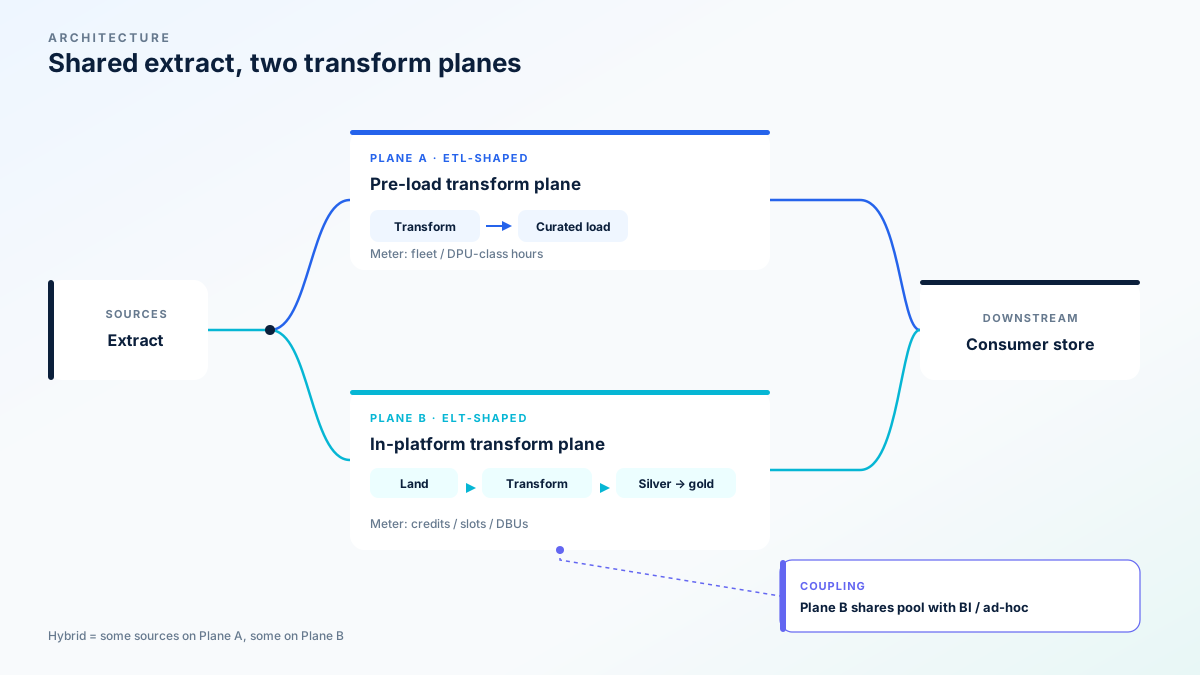
In classic ETL, transformation runs on a secondary processing server or specialised engine before curated results land in the consumer store. On cloud estates that often means Spark on Glue or EMR, Azure Data Factory Mapping Data Flows, Dataflow workers, or partner engines — a separate billable plane from warehouse analytics.
That plane wins when you must not land raw regulated data in the consumer store, when transforms are heavy or non-SQL, or when the target is constrained and you need to protect its compute. Azure Architecture Center calls out regulatory and compliance curated staging audits before loading, specialised transform engines, and offloading heavy work from a constrained target. Google Cloud’s BigQuery guidance recommends ELT to most customers, but still notes ETL when an existing transform process exists or when the goal is to reduce resource usage in BigQuery.
Waste on this plane is familiar: fleets sized to peak batch and left running empty between windows; multi-hop copies that add latency without adding control; brittle custom masking pipelines that duplicate warehouse governance features you already pay for.
In-warehouse / lakehouse transform plane (ELT-shaped)
In ELT, cleansing, transformation, and enrichment run in the warehouse or in the same lakehouse store that consumes the data. Synapse-style MPP ELT uses distributed query processing and can eliminate separate pre-load transform resources (Synapse ELT loading). Snowflake, BigQuery, and Redshift SQL — often organised with dbt or Dataform — are the common analytics-engineering shape. Lakehouse medallion designs land raw bronze, then validate and enrich through silver and gold on lakehouse compute (Databricks medallion).
Scaling the target often scales transform throughput. That is also the coupling risk: transforms compete with interactive BI unless you isolate warehouses or reservations.
Coupling to platform economics
Mechanism language matters more than list prices, which churn and should be checked at purchase time.
- Snowflake virtual warehouses bill per second after a 60-second minimum on start or resume. Suspending and resuming within the first minute can incur multiple minimum charges (Snowflake compute cost).
- BigQuery on-demand charges by data processed; capacity charges for allocated slot-time. Slot contention queues work. Autoscaling often retains scaled capacity for at least about a minute, so bursty transform jobs can pay for unused scaled capacity in that window (BigQuery slots).
- Lakehouse ingestion frequency trades cost for latency: continuous incremental costs more than triggered or batch paths for lower lag (Databricks medallion cost guidance).
Isolating transform workloads on dedicated warehouses or reservations improves cost attribution and keeps production transforms from relying solely on idle-slot fairness.
Recompute policy beats “ELT by default”
Choosing ELT does not make transforms cheap. Incremental materialisation is the real efficiency lever.
dbt incremental models transform only filtered new or changed rows after the first build, improving performance and reducing compute versus rebuilding all history. dbt run --full-refresh rebuilds from scratch and can cascade downstream when selected with +. Schema-change options such as on_schema_change reduce forced full-refresh scenarios when columns evolve.
Snowflake dynamic tables show the same pattern with sharper failure modes. AUTO refresh mode resolves once at creation to INCREMENTAL or FULL; if FULL is unexpected, every refresh reprocesses the table. Production guidance is to set refresh mode explicitly. Incremental performance is best when changes stay under roughly five percent of base data between refreshes — a guideline, not an auto-switch. Upstream TRUNCATE plus COPY INTO can generate delete-and-insert change storms that make incremental consumers expensive. REINITIALIZE and full rebuilds are significantly more expensive than incremental refresh (dynamic table cost; refresh modes).
Full rebuild remains a correctness tool. It becomes a cost incident when it is the quiet nightly default “to be safe.”
Freshness is a priced knob
Near-real-time ELT is possible via frequent in-warehouse refreshes, CDC into incremental models, or short target lags. It is not free. Snowflake documents that short dynamic-table target lag increases Cloud Services change-detection work even when many refreshes return no data — for example, 200 dynamic tables at a one-minute lag imply on the order of 288,000 change-detection checks per day (vendor example, not a Yottalyte measurement). Databricks documents continuous incremental ingestion as higher cost and lower latency than triggered or batch paths.
Batch ETL windows remain efficient when the business SLA allows hours rather than minutes. Edge ETL that filters, averages, or cleanses before cloud load can reduce volume and rate for IoT-style sources — an AWS-documented fit where pre-load transform pays for itself in bytes never landed.
Streaming and CDC are related freshness levers; they are not the primary compare in this article.
Engineering effort and operating model
ETL typically requires more upfront definition of target structures and relationships, and concentrates compliance evidence at curated staging. The trade-off is more moving parts across extract, transform engine, and load — with schema contracts that must hold at the pre-load boundary.
ELT splits extract-and-load from transform and lets SQL-first teams iterate in the warehouse with tests and documentation in the transform repository. Google Cloud recommends that split to most BigQuery customers for that reason. The trade-off is governance of raw zones, warehouse FinOps hygiene, and refresh-mode discipline — ownership that must be explicit at handover.
Schema contracts and tests belong at the boundary that fails: pre-load for ETL; warehouse or lakehouse models for ELT. Prefer contract-driven change over “fix by full rebuild every night.”
For white-label and co-delivery, partner teams retain client and commercial ownership. Implementation capacity is accountable for the artefacts that decide the pattern: PII landing rules, transform warehouse or reservation ownership, explicit refresh modes, a controlled full-rebuild calendar, and multi-destination publish paths when curated publish must leave the warehouse.
When ETL still wins / when ELT wins / when to hybridise
| Lean toward | When |
|---|---|
| ETL | Regulatory or compliance curated staging audits before loading; heavy or specialised transforms; constrained consumer store; edge or IoT volume reduction; legacy fixed formats where one-time reshape beats perpetual raw landing; multi-destination curated publish |
| ELT | Elastic modern warehouse or lakehouse; SQL-friendly transforms; raw retention for exploration, audit, and reprocessing; team can run incremental models and isolate transform compute from interactive BI |
| Hybrid | ETL for some sources, ELT for others; light land-to-bronze plus silver/gold in-lakehouse transforms, with selective pre-load masking when policy demands |
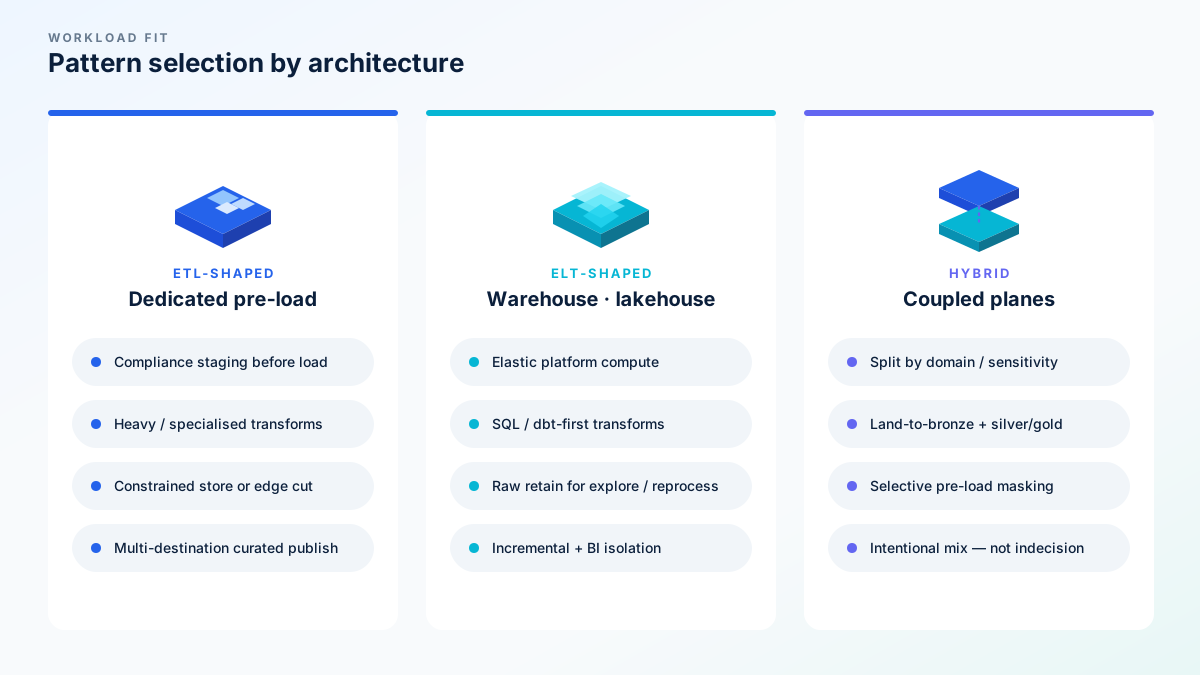
Azure’s choosing section is the clearest primary “when each wins” frame. AWS documents legacy formats, experimentation, hybrid multi-format analytics, and IoT edge processing as ETL-shaped fits. BigQuery still documents ETL when protecting warehouse resources. AWS Redshift lake-house patterns still advise analysing data types, transform nature, row-by-row versus set-based SQL, SLA and growth, and cost of the solution before choosing — older guidance that remains mechanism-valid.
There is no universal winner. Workload shape first; acronym second.
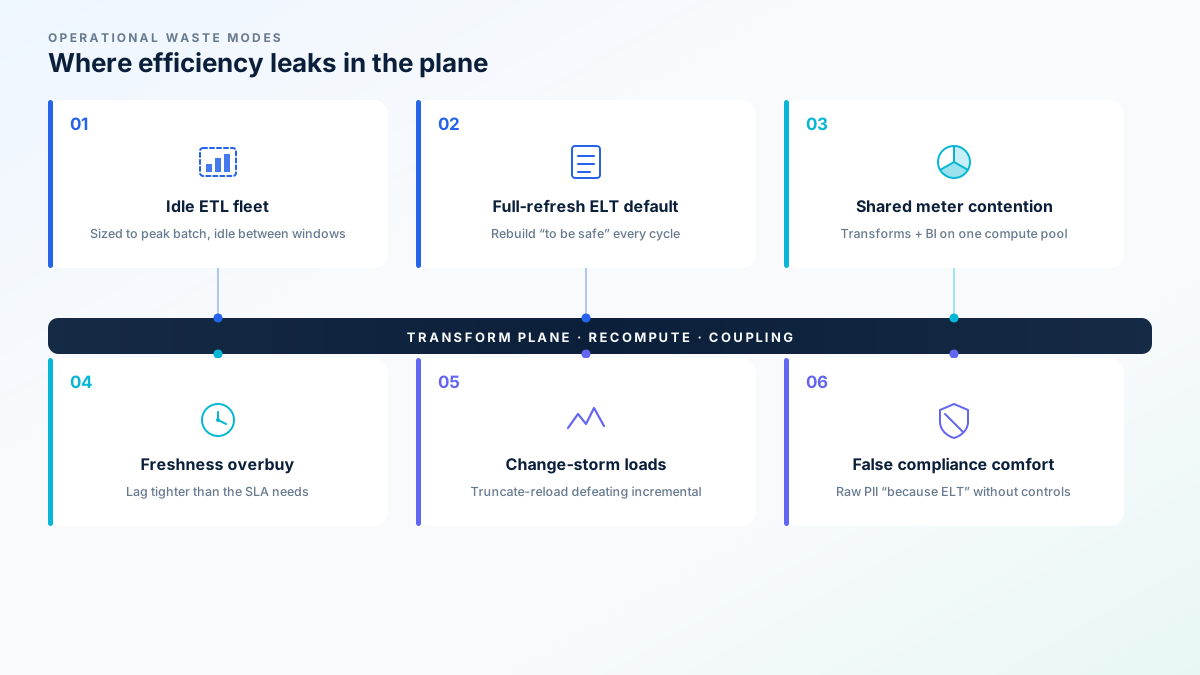
Failure modes (waste checklist)
- Idle ETL fleet — sized to peak batch, burning spend between windows.
- Full-refresh ELT as quiet default — dbt
--full-refresh, Snowflake AUTO resolving to FULL, or nightly rebuild “to be safe.” - Shared meter contention — heavy transforms and interactive BI on one warehouse or slot pool.
- Freshness overbuy — one-minute lags or continuous streams without an SLA that needs them.
- Change-storm loads — truncate-and-reload patterns that defeat incremental engines.
- False compliance comfort — landing raw PII “because ELT” without the pre-load controls policy actually requires.
Implementation handover: questions that decide the pattern
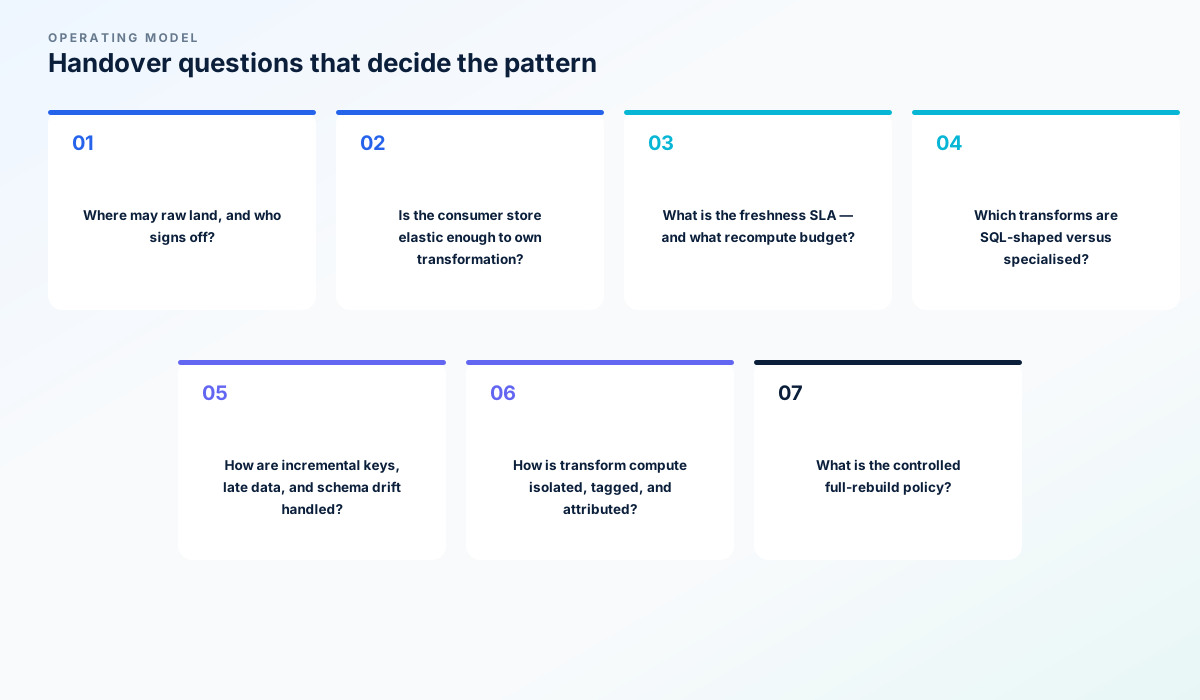
Force these answers in discovery and design — before anyone brands the pipeline:
- Where may raw land, and who signs off?
- Is the consumer store elastic enough to own transformation?
- What is the freshness SLA in minutes or hours — and what recompute budget does that imply?
- Which transforms are SQL-shaped versus specialised or non-relational?
- How are incremental keys, late data, and schema drift handled?
- How is transform compute isolated, tagged, and attributed?
- What is the controlled full-rebuild policy — calendar, owners, and blast radius?
What this is not
- Not a vendor bake-off or ranking of EL tools, warehouses, or transform frameworks.
- Not an “ETL is dead” essay — cloud architecture docs still document when ETL wins.
- Not a step-by-step Glue, ADF, or dbt tutorial.
- Not a restatement of the modern data platform operating-model checklist, production GenAI evaluation, or platform-engineering paved-roads thesis.
- Not a claim of formal partnerships or certifications with any named platform — technology names here are capability coverage language.
Operational implications
If the team only debates ETL versus ELT as brand identity, efficiency work never starts. The durable deliverable is an operating model: transform-plane placement per source class, incremental defaults with an explicit full-rebuild policy, isolation of transform compute from interactive workloads, and handover artefacts that answer landing rules and freshness budgets.
That work sits naturally under Data Engineering & Modern Data Platforms and Analytics & Decision Intelligence, with continuity through Managed Data, AI & Cloud Operations when refresh modes, attribution, and rebuild calendars must stay owned after go-live. Prefer durable transform economics over impressive acronym decks.
References
Primary sources used for technical claims in this article. Inline citations in the body remain authoritative for the locus of each claim.
- The difference between ETL and ELT — AWS
- ETL and ELT design patterns for lake-house architecture using Amazon Redshift (Part 1) — AWS Big Data Blog (13 December 2019)
- Extract, transform, and load (ETL) — Azure Architecture Center
- Design ELT data loading for dedicated SQL pools — Azure Synapse
- Introduction to loading, transforming, and exporting data — BigQuery
- Understand slots — BigQuery
- Understanding compute cost — Snowflake
- Dynamic tables: understanding cost — Snowflake
- Dynamic table refresh modes — Snowflake
- Medallion lakehouse architecture — Databricks
- Incremental models — dbt Docs
Planning where the transform should run?
YottaLyte works with consulting partners, technology vendors and enterprises across Data, AI, Cloud and Platform Engineering.
Discuss a project →